
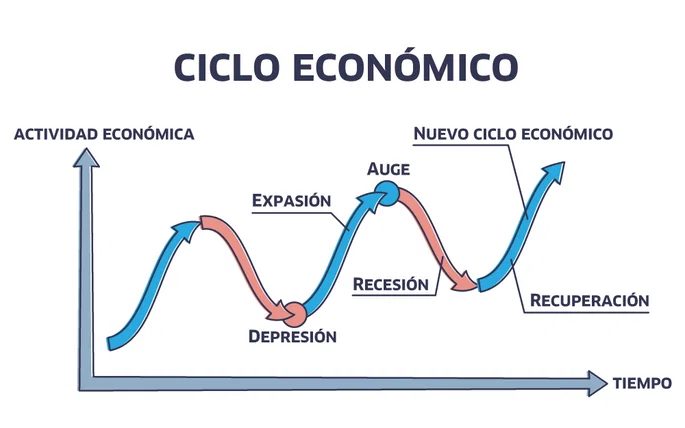
A business cycle is simply a series of periodic oscillations. Track how economic variables in different countries rise and fall over time. There is no fixed schedule. Some cycles only last a few years. Depending on specific national circumstances, it can take several decades.
The pattern repeats itself endlessly. It goes through increasing and decreasing phases until the sequence is reset.
Expansion and peak growth
The first two stages represent growth. Economic expansion. The demand for products and services has increased. Production increases to meet demand.
This period is profitable. Investments are increasing. Jobs are created. Companies have a lot of confidence in hiring and spending. The general state of the market is improving.
Recession and depression
The next two stages mark a downturn. The economy weakens. Demand fell sharply. Production slows down as a result.
The unemployment rate rose. This has a negative impact on the standard of living. Consumers’ purchasing power is weakening. People have less and less money to spend. This cycle continues until the expansion finally resumes.
Business cycles are defined by four different phases: expansion, peak, recession and depression.
Why are these steps important?
Understanding these steps can help investors and companies make better decisions. Understanding the state of the economy enables more accurate forecasts to be made. It’s more than just tracking numbers. It’s about being aware of the underlying dynamics of the market.
Each stage has its own characteristics. Identifying them will give you a clearer picture of where the economy is going. This information can influence everything from hiring practices to investment strategies.
Responding to market fluctuations
The transition between stages is rarely smooth. Changes can happen gradually or suddenly. The duration of each phase varies widely. There are periods of expansion that seem endless. Others end abruptly.
Depression is the hardest phase. It is accompanied by a severe economic contraction. Recovery from this point can take a long time. Preparing for economic downturns is crucial for long-term stability.
Engine roar: expansion and peaks
We call it expansion, but really it’s just growth wearing a suit. This is where the financial engine finally fires up. Investments are picking up. The consumption of goods and services has skyrocketed. Employment increases because factories, offices and retail stores need people to meet demand. Everything happens synchronously. Money flows incredibly easily. GDP rises. I feel like I’m making progress.
But progress has its limits.
This is the boom phase. “techo”, above. The economy reaches its maximum possible output. unemployment? It’s at its lowest point. Everyone works. Everyone is buying. The demand was so strong that the prices started to rise. Companies take on debt to continue growing. People borrowed money to buy growing assets. It’s a self-reinforcing cycle of confidence and influence.
Then the music stops.
The situation collapsed under its own weight. The debt burden became too heavy. Inflation weakens purchasing power. The boom does not end in an explosion, but in a whimper of default and hesitation.
Slow bleeding: recession and depression
Recession is just a word used to describe the deflation of that earlier bubble. Production may not collapse overnight, but growth will stop. It stalls. It can also shrink. The demand for raw materials decreased as factory production decreased.
Here’s a trap. Prices will stay high for a while, but people will spend less. They’re scared They are paying off their debts. Investments dried up. Unemployment increased gradually, first slowly and then faster. When income decreases, consumption also decreases. GDP falls. The variable is moving in the wrong direction.
Then comes the bottom. depression. Or call it the “crisis floor” in polite company.
At this point, everything is at its minimum. Investments are missing. The production is low. Consumption is terrified. There are too many products and not enough buyers, so prices fall. But what about the unemployment rate? It was an absolute peak. This is the coldest part of the cycle.
How long does the pain last?
Cycles are not random. They have a rhythm. Historians and economists have drawn them in periods. If you want to predict the next recession, start by understanding the length of these cycles.
- Kitchin Cycle (3-5 years): This is a inventory cycle. It’s very short. Track the time companies take to store and sell their products. This is a pulse check on your financial situation.
- Juglar Cycle (7-11 years): This is the business investment cycle. longer. This reflects the time it takes companies to invest in new machinery, expand production capacity and wait for a return on their investment. Here we often feel the “real” ups and downs of the business world.
- Kuznets cycle (12-25 years): Infrastructure. This is a long cycle of public and private spending on buildings, roads and housing. It is slow to build and slow to decay.
- Kondratiev Waves (45-60): Big waves. This is the Kondratiev cycle. It follows the broader stages of capitalism itself. technological revolution. The economic structure has changed significantly. This is a cycle within a cycle. The crisis referred to here is not just a recession. This means questioning the foundation of the system.
Why does this happen? Three explanations
If you want to understand boom and bust mechanism, you need to study the theory. they don’t agree. This difference of opinion is behind policy decisions.
Real business cycle theory
This theory was born in Chicago in the 1980s. It’s cold and mathematical. We believe that the cause of the spiral is external. It’s not money. It’s not politics. *Technology. *
According to this view, productivity shocks (usually caused by technological change) drive the economy. Markets are efficient. Adjusting prices and wages. The economy is “supposed” to be able to adapt. However, when productivity declines, the you get a downturn. This is not a failure of the system. The system absorbs shocks as planned. Volatility is a rational reaction to external variables.
Austrian School
Friedrich Hayek led this work. They hate central banks. They believed that the market, not a committee in a marble building, should determine the money supply.
Their argument is specific: central bank intervention. They feed money into the system. This makes interest rates appear artificially low. Entrepreneurs look at this cheap money and think, “There’s more money than there really is.” They start investing in unsustainable projects. They build factories that don’t need to be built. There is no market demand for the products they develop.
This is false boom. It is driven by bad signals. Eventually the reality will show and the costs will rise. The money is not there. Investments must be given up. Economic contraction. A recession means that the market corrects the central bank’s mistake. It’s painful, but it’s necessary.
Keynesian perspective
John Maynard Keynes took a completely different approach. He is not interested in the “natural” equilibrium of the market. He is interested in what happens when people stop spending.
Keynesian theory focuses entirely on aggregate demand. Consumers and businesses consume less, and without government intervention, production declines. Employment has decreased. Income is decreasing. Demand will decrease even more. This is the death spiral.
What is the solution? Government intervention. Keynes believed that during a recession, the government must intervene through fiscal policy. Tax reduction. More public spending. Use monetary policy. When interest rates fall, the loan becomes cheaper. The goal is to artificially boost demand to start the engine. If the private sector doesn’t spend the money, the government will.
Compromise
There is no perfect theory here. It’s just a trade-offs.
The Austrian view warns that government intervention often delays necessary correction and creates bigger bubbles later. The Keynesian perspective warns that inaction leads to long-term suffering, high unemployment and the loss of human potential. Real Business Theory suggests that “fixing” productivity shocks is pointless.
Which do you believe? It depends on your risk tolerance. Do you believe that the market can self-correct, even if it is injured, or do you believe that the state can stabilize the chaos, even if it distorts the market?
The cycle goes on all the time. The question is not how to stop it. This is how you survive the bottom and prepare for expansion. Most people wait until the economy improves to start thinking about their finances. By then, the easy money will be gone.