
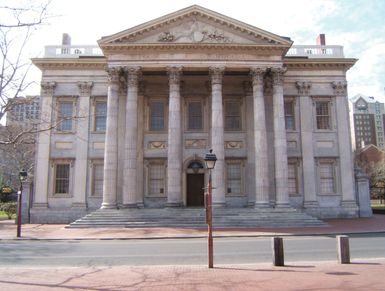
If you walk past the First Bank of the United States in Philadelphia today, you see a quiet relic in Independence National Historical Park. But when it was built, it was the center of a financial war. That building represents the start of a complex story about who controls money in America.
A national bank is not just any bank with a government stamp. It is a specific type of commercial bank. It is chartered and supervised by the federal government. Yet, it is operated by private individuals. This hybrid status has defined American finance for two centuries.
The Early Experiments: 1791 to 1836
The first attempt at a central banking system began in 1791. The First Bank of the United States operated for twenty years. It closed in 1811. The second attempt started in 1816. It lasted until 1836.
These banks were agents of the U.S. Treasury. They did not work alone. They competed directly with state banks and private banks. This competition had a specific goal. It forced private banks to redeem their banknotes at full value. Without that pressure, paper money was often worthless.
The second bank provided stability. But stability is unpopular with politicians. President Andrew Jackson hated the institution. He viewed it as a monopoly. Because of his opposition, its charter failed to renew in 1836.
The result was chaos. State banks issued whatever notes they wanted. There was no central oversight. This unstable period lasted until the American Civil War. The war itself exposed the system’s failure. Financing the conflict proved impossible without a better banking structure.
The National Bank Act of 1863
The Civil War forced Congress to act. The National Bank Act of 1863 created a new system. It established national banks under federal charter.
The goal was a uniform currency. Before this, every bank printed its own notes. Some were reliable. Most were not. The 1863 act changed the rules.
Here is how the mechanism worked. Each national bank had to deposit federal bonds with the comptroller of the currency. The comptroller, often called the national banking administrator, issued currency backed by those bonds. If the bonds were good, the money was good.
The act also set strict rules. It defined minimum capital requirements. It limited the kinds of loans banks could make. It mandated reserve levels against notes and deposits. It created a system for examining banks. The intent was clear. Protect the noteholders.
State banks still existed. They could still issue their own currency. But Congress added a weapon. It imposed a 10 percent tax on state banknotes. That tax was a death sentence. No private bank could afford to pay a 10 percent tax on its own money. The rival currency vanished overnight.
The Rise of the Federal Reserve
The new system solved some problems but created others. National banknote supplies were inflexible. They could not expand or contract quickly to meet economic needs. Reserves were scarce.
This rigidity caused frequent panics. The financial system needed a shock absorber. In 1913, Congress created the Federal Reserve System. It was designed to provide elasticity to the currency.
It took time for the transition to complete. By 1935, national banks had transferred their note-issuing powers to the Federal Reserve. They stopped printing their own money.
Today, the landscape is different. National banks are primarily commercial. Some still handle savings and trust functions. The regulatory burden is shared. The Federal Reserve shares supervisory authority with the Office of the Comptroller of the Currency. The OCC charters, regulates, and supervises national banks.
The history